After a grueling ten-and-a-half-hour flight to London, and then another hour-long flight to Dublin, the plane descended through the soft, puffy whiteness revealing the land I have been waiting to return to for eight years. The lush green island of Ireland was a welcome sight, one I had been planning on for the entire past year. When I found out I was accepted for an artist residency program in July of 2023, I was very excited to know I would visit Ireland again. I fell in love with it in 2016, and knew that feeling would never go away.

Fortunately, the customs line moved very quickly, and before I knew it, I was at the baggage claim area looking for my luggage. When no more bags came out onto the carousel, I began to panic since that brand new, giant suitcase I had bought for this trip contained all my art supplies for the month. Fortunately, within moments, I found it by the other carousel which had already stopped. I was thrilled it had made it all the way from San Francisco and hadn’t been lost.
I found the correct bus to take into Dublin and to the train station. The ride became a small tour of the city which revealed its growth and development. There were several large construction projects in progress with numerous large cranes added to a horizon of tall, modern buildings. As the bus made its way along the Iffy River through the center of Dublin, the modern buildings became smaller, and older brick buildings began mixing in, moving away from contemporary architecture and into the past.
The bus dropped me off at Heuston Station, and I walked into a very crowded scene. The majority of people waiting for trains were young people. I figured out how to buy a ticket from the machine, then began searching the electronic billboard above the crowd for the train to Galway. All signage in the Republic of Ireland is written in Gaelic first, then in English. It took me a minute to adapt.

When the announcement came to board the next train, and the gate lights turned from red to green, a huge mob of young people raced through the gates, running toward the train. When the Irish Rail workers saw this, they yelled at everyone to walk and not run. I wondered if this was the scene all of the time. I asked a rail worker if I would risk not getting on my train with so many people racing to board. He replied, “Taylor Swift was on that train. That is why they were all rushing.” She had just performed in Dublin that weekend. I couldn’t believe I had come all the way from America to compete with Taylor Swift for a seat on a train!

Once on board the train to Galway, I met two young men from Morocco who helped me put my bags on the rack above our seats. Then a man closer to my age joined us as we sat across from each other. His name was Tom Murphy, and he was as Irish as they come. We all began conversing with each other as the Irish landscape rolled by. We talked about Ireland, and Morocco, and the US. I learned there is a city in Morocco entirely painted in blue. Tom Murphy wasn’t sure whether there were more cows or sheep in Ireland. I spoke about the monster named Trump. Tom agreed. The Moroccans were surprised. There were moments when I could barely stay awake. Through the window, Ireland was so beautifully green.
Arriving in Galway, I pushed my four-wheeled bags, following the crowd, over many brick and cobblestone walkways until I reached a familiar sight, Eyre Square in the middle of the city. What a vibrant place Galway is, full of people, many of them young, and full of pubs, and shops, and rows of brick and stone buildings which have been there long before I arrived on this earth. The place exudes charm, character, and history. I was so glad this would be home for the next month. After finding a grocery store called Dunne’s, I bought the basics and crammed them into my suitcase. I went back to Eyre Square and found a taxi which took me to Watershed Studios.
Arriving there around 4:30, the taxi driver could not see signage, and no one appeared to be there. After knocking, I walked inside and recognized the interior from a photo on their website. Moments later, the taxi left, then a car pulled up, , and three people got out. Two of them were the other two artists from the US, Will and Cynthia. We would all be living together for the month. The driver of the car was the owner of the place, Padraig O’Malley who lives in the front house.
Will is 38 and a photographer. Cynthia is closer to my age and works with encaustics and paint. They had arrived before me, and had already picked out their rooms. Padraig had given them a ride to get groceries. Will, Cynthia, and I went inside and started to get to know each other. I think we ate some dinner. I know that I headed up to bed at about 6:30. I hadn’t had any sleep since 3:30 in the morning the day before in San Francisco. It was great to finally be horizontal.
I woke up around 10:30 pm and looked out the window just outside my bedroom door. Glenlo Abbey, a five-star hotel and country club, was starting to light up under a prolonged setting sun in the short nights of summer in Ireland. It was a lovely end to a very long day.
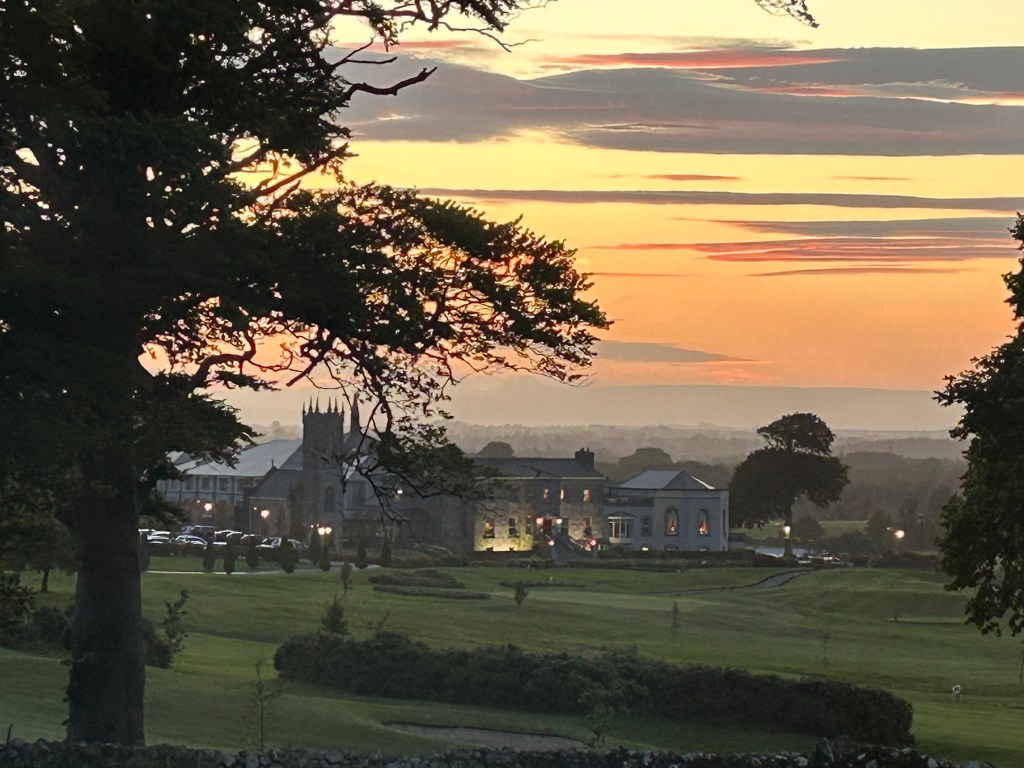
The next few days were fuzzy because I kept taking naps and being awake during the night. But I have a collection of memories, mostly in pictures.

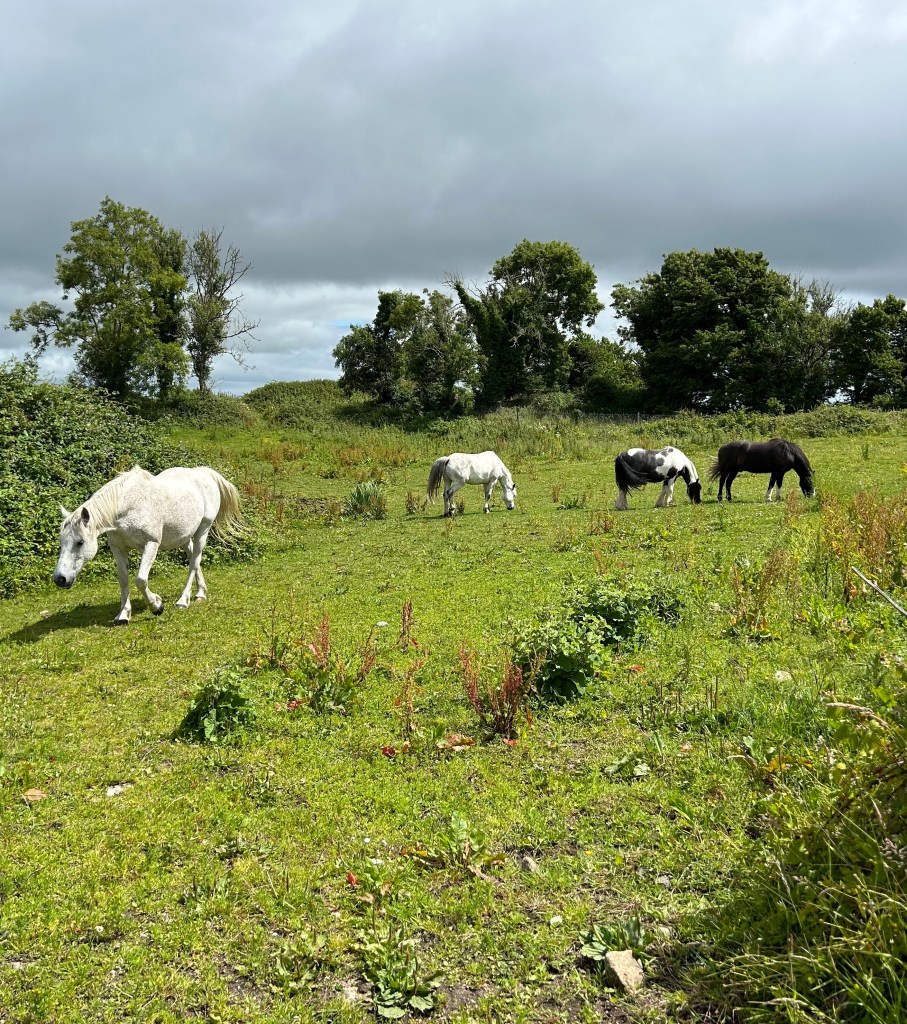
The rooms at Watershed Studios are nice. There are enough rooms for six artists. Geraldine, Padraig’s wife, who runs the place. Her daughter Grace does the booking and artist selection. Grace lives and works in Dublin. The surrounding property owned by the O’Malley’s includes a long strip of land reaching down to the River Corrib. On the main road at the top of the driveway across from the main house is Kelehan’s Pub. Between sleeping and eating, there were a couple of walks to the river, the petting of some lovely horses boarding in the pasture, and my first pint of Guinness with Will and Cynthia at the pub at the top of the driveway.


My first goal was to go to Connemara, a region just northwest of Galway, so I could begin some paintings of the luscious, dramatic landscape. I had driven through it eight years ago. Prior to arriving, Will and Cynthia had agreed for all three of us to rent a car together. But, once they had arrived, they were hesitant when they saw how fast cars drove on the road in front of the house. And driving on the left was, understandably, a bit terrifying to them. It is the Clifton Road that goes straight into Connemara, beginning a few kilometers down the road from Watershed Studios.
Without a car, I was perplexed about how to get there. There is a bus, but very few people seemed to know anything about it. On the morning of July 4th, I started walking down the road in that direction hoping to see a bus stop somewhere along the way. I only got as far as the Abbey and golf course adjacent to where we were staying when I asked a maintenance employee working by a gate near the road. She said the bus had just gone by earlier, and that there wouldn’t be another one “for a while.” She also said there are no bus stops, so you just have to watch for it and flag it down. This was all very unreliable and discouraging.
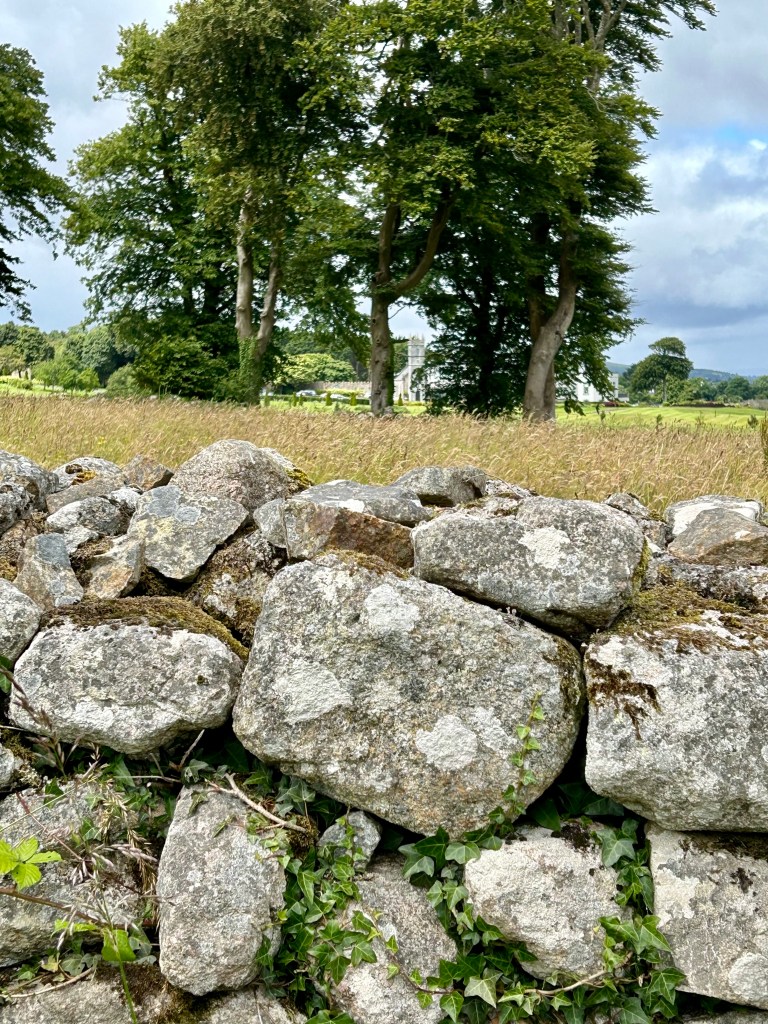
I had no interest in hotels or golf courses, so I cut across the property on a sandy path, and climbed over the stacked rock wall that separates the golf course from Watershed. I attempted to start a sketch in my studio, but had to go back to bed mid-morning. When I awoke, I went back to the studio space I shared with Will, and we both quietly worked for a few hours on beginning attempts at creating our art.
By late afternoon, I decided to walk into Galway and go to the bank to exchange some dollars for euros. I left at 4 pm, but just missed getting into the bank which closed at 5. It was a healthy walk along a busy highway, over a wide river, and through a complex network of streets. The entire walk was 5 kilometers (a little over 3 miles.) There was a row of ATM’s in the lobby outside of the bank, so I made a withdrawal from PayPal.
We had all agreed to meet at a pub called Crane’s where storytelling takes place on Tuesday and Thursday nights. Google maps took me on a very roundabout adventure through some backstreets, around the Cathedral, and over the river again. I finally found Crane’s. Will and Cynthia arrived soon after and were sitting at a table. I joined them and could see that they were also exhausted by the walk.

Sitting next to me was a young man named Harry from New York who was a high school ESL teacher. We got into a long conversation about teaching, and about how necessary it is for teachers to take a break and travel during the summer. It was really nice talking to him and encouraging to meet a young person who has the same idealism I have about working with immigrants and supporting opportunities and possibilities for their future.
Unfortunately, we found out the storytelling was canceled due to illness. Will decided to head out on his own for the evening. The pub was getting louder, and I was ready to go home. We said our goodbyes to Harry, and Cynthia and I called a cab to take us back to Watershed.
I had booked a bus tour of Connemara for the next day. When I arrived in the morning, I was given a name tag to wear around my neck, and boarded quickly to sit near the front. The driver was a character, as I expected he would be. When we pulled out of Galway, he was already making jokes and telling stories. Our bus drove right past Watershed Studios as we headed for Connemara.
I was again astonished at the raw beauty of the mountains covered in carpets of green, and the wide-open spaces dotted with sheep, scattered with glacial lakes, and laced with endless dry-stone walls. But it was frustrating to photograph all the incredible views through a slightly tinted window reflecting passengers and seats. Raindrops clung to the outside of the glass. The blur of foreground racing by was irritating for me as a painter who was trying to capture landscape in photos.
Our first stop was Kylemore Abbey, built in 1868 for a family from England. In 1920, it was bought by Benedictine nuns and became an abbey. The building was closed for tours because of restoration work, but the grounds were available for walking around. When we got off the bus, I told the driver I was a painter and was hoping to get some good photos of the landscape, but said it was challenging from a side window. He immediately offered the front seat on the bus next to him. There was a fold-down seat normally used for a tour guide. I was thrilled and very thankful for the opportunity.
I was not interested in the Abbey (or any abbeys), although the setting was amazing. While there, I learned about Connemara Ponies, which were originally wild horses. They are mostly all adopted by locals now. Some think they were brought by the Spanish, but are still called a native breed. Foxes, pheasants, and swans seem to be the only other native wildlife, unless you consider all the black-faced sheep freely wandering around the hillsides and roads, climbing over walls and fences, and frequently blocking the roads.
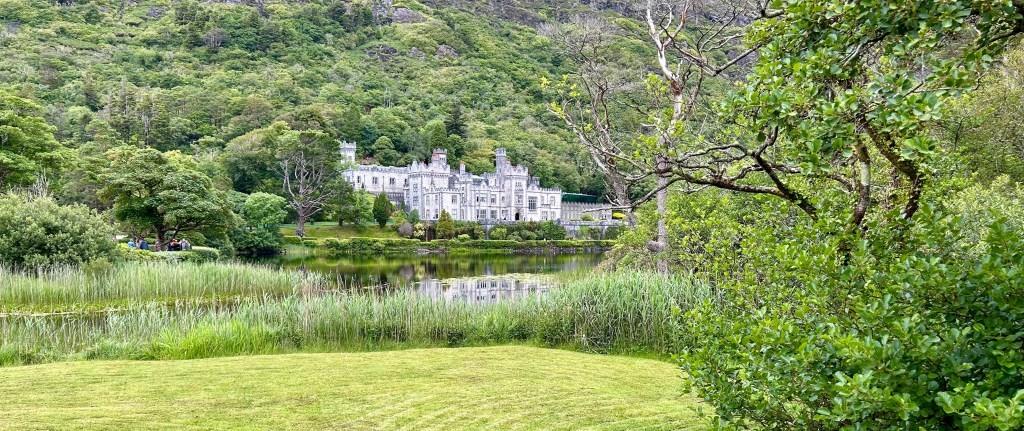
When we got back on the bus, I definitely had the best seat. As we drove along the narrow roads of Connemara, I could see everything right in front of me. The bus driver stopped several times for us to get out and take photos. There is a fiord in a place called Killary Harbour with amazing vistas. The bus turned on to an even narrower road and took us to what seemed to be the most remote place in Ireland. After some twists and turns, we arrived at Lough Na Fooey, a stunning lake tucked away and seemingly far from anywhere. I knew I would be painting this view when I got back to the studio.

The constant thing about Ireland is that you can be driving along vast, uninhabited places when suddenly there is a town with some shops, a pub, and most likely, a church. Ireland is rural almost everywhere, and yet there is a town about every 20 miles in any direction, and a strong sense of community among the people. Connemara is unique, and breathtaking, and not to be missed.
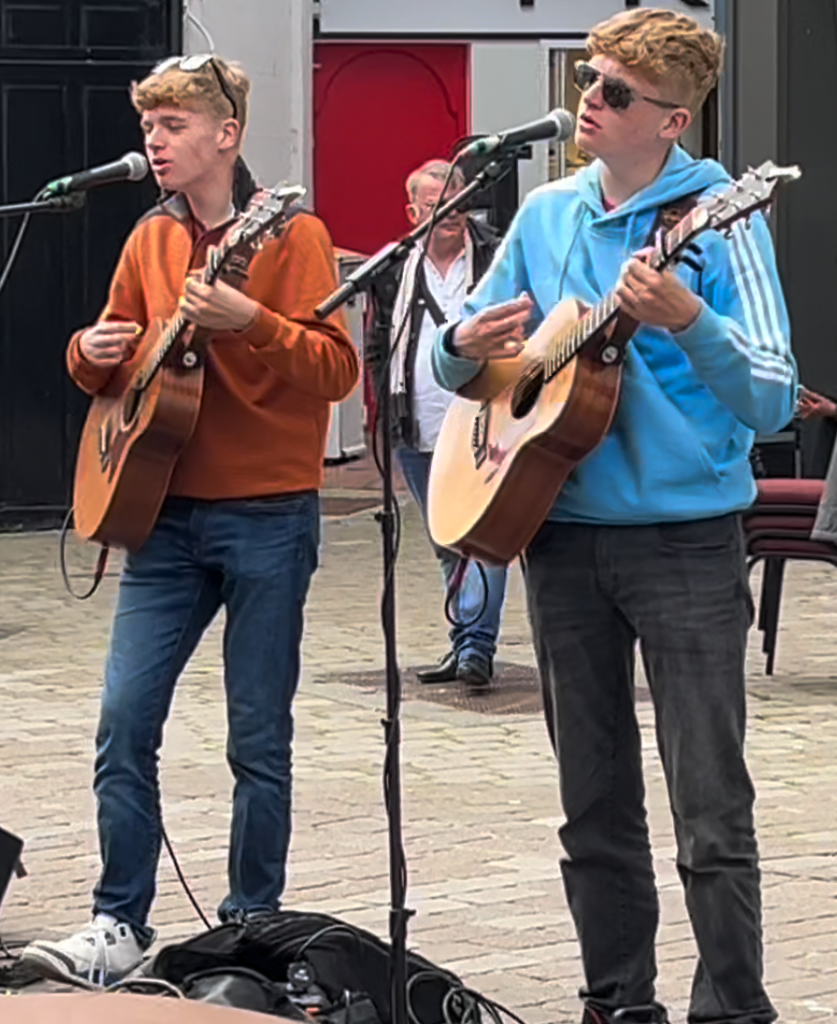
The next day was Saturday, and it was recommended that we go to the farmer’s market in Galway. I made my way there by walking the one-and-a-half miles to the bus stop just inside the city limits of Galway, then paying two euros to be dropped off at City Centre. The streets were busy, and I could hear music playing. Galway has several streets blocked from car traffic. There were buskers everywhere. I saw twin brothers playing guitar and singing with the exact same voice. They looked very Irish, with strawberry blonde hair, fair skin, and freckles. The next street artist I saw was a puppeteer. He had a marionette of himself playing the violin. It was mesmerizing to watch. Many children were standing around watching him.
I bought some strawberries at the farmer’s market, then wandered back toward Eyre Square, passing more buskers, and really loving being in Galway on a Saturday morning. Eventually, I walked back to catch the bus. All the walking on hard surfaces took a toll on my energy. The bus dropped me off about a mile-and-a-half from home. The driver told me I could buy a Leap pass and “top off” when it needed more money on it. The local bus was my new ticket to travel.

The walk home started becoming more familiar. If only for a month, I was living in Ireland!
I finally got some work done in the studio, finishing my first little collage, ate a late dinner, and went to bed after 10 even though it was still light.
On Sunday in Ireland, most things are closed. On this day I spent most of it in the studio doing a small painting of one of the several views I saw in Connemara. I took a break to go for a walk down to the river and met up with Geraldine and her dog as she was walking back. She takes that walk every day. She loves Ireland deeply and would never want to live anywhere else. Her family history goes back centuries. I asked if I could borrow her vacuum, and as we entered her house, she asked if I would like a glass of wine. She went out to her car to get something, and saw Will as he passed by. She invited him to join us. She brought out cheese and almond croissants. We had a long conversation about Ireland, and America. It was great to get more insight into the lovely Emerald Isle.
After a mostly sleepless night, I began a new, larger collage when I got into the studio. I worked continuously until about mid-afternoon. Then I headed into Galway. After walking to catch the bus, I arrived at City Centre and went straight to the bank. It turns out, there is no place in Galway to exchange American dollars. The closest place to exchange money is Dublin. After withdrawing from my PayPal card, I found the post office around the corner and bought my bus pass. Back around another corner, I found a store that carried some basic art supplies. I bought more foam core, a better pencil sharpener, and some scissors. I went to the grocery store and bought a few more food items. I then walked to the bus stop on Eyre Square and waited for my bus back to the edge of town. Although it was less walking around than before, the hard stone, brick, and asphalt walkways for this quick trip to town took a toll on my feet, and my neck, shoulders, and lower back. By the time I returned home, I retired to bed early.
I slept very few hours during the night and woke up tired. I finally got myself into the studio and made progress on my painting. At some point in the early afternoon, the internet quit, so I went to tell Geraldine in the front house. She invited me in for tea and homemade, buttered brown bread. Delicious! It was nice to converse with her one-on-one. She told me about her children and grandchildren and showed me pictures. I told her about working with primary school-aged kids. She suggested I go sit in the greenhouse with my feet up and take a nap. I wasn’t able to nap, but it was lovely, and again, I felt grateful to be in Ireland.

There was a shift of rooms because of possible new artists coming, so I ended up moving downstairs into a much larger room with a private bathroom. I was grateful for this.
I spent the whole next day in the studio painting, and finished my first, bigger piece. I walked down to the river for a break on a beautiful warm and sunny day.
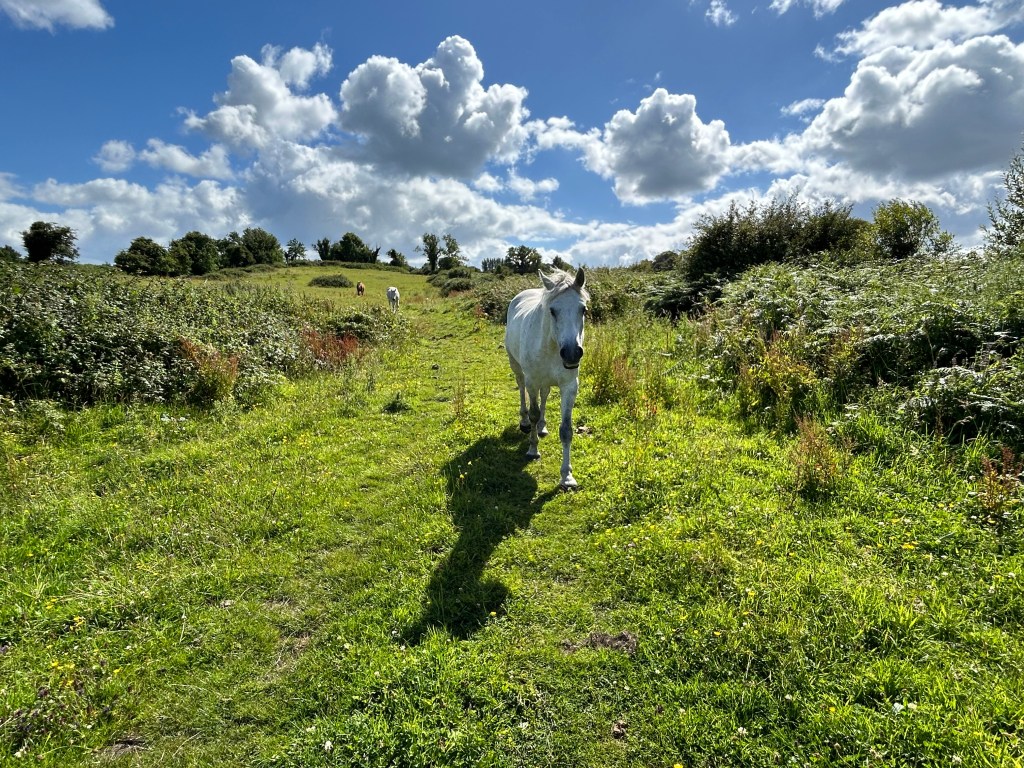
The next day, Will and I ended up renting a car in Galway and headed out to get inspired by driving into Connemara. Although it was expensive to rent a car, it was great to have the freedom to go where we wanted to go and be independently mobile. Will wanted to go to a lake, Lough Corrib, so we drove to the closest town, Oughterard, and found the shoreline of a dark, deep body of water with wind and waves and big, black volcanic rocks. It was exactly what he was looking for. He brought his rangefinder camera and shot a whole roll of film.

We continued on across Connemara, turning onto small side roads (or driveways?), stopping to take pictures of amazing vistas. We found a stone bridge over a small, hidden creek I chose to incorporate into my next painting. The mountains in Connemara are so unique and stunning. I was so glad to be there again.

In the following day, with more images of Connemara to work from, I spent the day in the studio finishing one and starting another. It was a productive day.
I was now in the groove with walking to the bus stop, riding the bus into town, and shopping at Dunne’s grocery store. I was living in Ireland, painting every day, and loving it.
The news of the assassination attempt on Trump came in the middle of that night. I couldn’t sleep after hearing about it. In the morning, after finishing a painting, I needed to get out and ride around on buses. I knew it would help clear my mind. I caught one that passed Watershed and goes all the way across Connemara to Clifton. I only went as far as Mollycullen. It was Sunday. I knew hardly anything would be open, except for pubs, of course. So, after getting off the bus, I entered Regan’s Pub and ordered a pint. Inside, many people were there at 3:30 in the afternoon because soccer was on television. I quietly drank my Guinness and ate a small bag of potato chips. Then I caught a different bus back toward Galway.
Once in Eyre Square I decided to wander through the Latin Quarter. It was full of people and was very festive. I looked at Aran sweaters, and even tried one on. I realized I wanted to go to the Aran Islands and compare prices and styles. I passed by the statue of Galway Girl and felt like I had finally found the center of it all. I took my usual bus home, and realized that all the time on the buses, in stores, and in pubs, no one was talking about what happened in America. It was a healthy end to a day which had started as troubling and depressing. I was glad I got out.

I woke up early and decided it was the day to go to one of the three Aran Islands I hadn’t been to before. I headed into Galway and went to one of the many storefronts called Aran Island Ferries. I asked the young woman at the counter which island I should pick. She suggested Inisheer because it was smaller and less touristy. As we began the transaction, she asked how to spell my last name. It turns out, she was a McGarry too! She handed me my ticket. I replied, “Thank you, Cousin.”
The bus headed west out of Galway along the southern shoreline of Connemara. There were lovely little beaches and very calm water. Many people were swimming in Galway Bay at these beaches. It wasn’t even 10 o’clock in the morning. Geraldine swims there every day.
After boarding the ferry and floating away from the dock, I noticed there were several Irish people, including children, and not just tourists on the boat. The kids were all dressed for soccer, going to the island for a match. The ride was smooth. It was exciting to, once again, be on my way to the unique islands where time stops and life is simple.
The ferry goes to Inishmaan first and lets people off there. Others board to go to Inisheer, my destination. When we docked at Inisheer, everyone started walking into the island from the pier. Inisheer is only three kilometers in diameter. There are very few street signs or maps. You just start exploring. Several bike rentals are available at the harbor. I thought about renting one to go to O’Brien Castle which stands on the top of the island. However, I don’t like riding uphill on a bike. I figured I would ask around for directions, and just walk.
I wandered down the first small road off of the main one because there was a sign for an “Art and Craft Shop.“ I walked through a neighborhood of homes. They were all surrounded by dry rock walls. A few cows lazily ate grass in some of the small enclosures. Finally, I came to a small house with a sign that read “Sweaters and Gifts,” (in Irish first, of course.) I walked into the lovely little store, and it was magical!

There were little twirling candle holders, a small beginner’s weaving loom made out of beechwood, and sweaters, all made on the island by locals. There was no one there except the sound of a woman’s voice singing through the sound system in Gaeltacht. It was hauntingly beautiful. Everything looked better to the sound of her voice. Then I saw my sweater!
It was the only green one of the small assortment they had. As soon as I put it on, I knew I had to buy it. Just then I turned around and a man appeared behind the counter who had silently slipped in from behind a curtain. I could see an infant seat propped behind the counter, but no baby in it. My guess was the baby was asleep in a room beyond that curtain.
As are most people in Ireland, he was very kind and mild-mannered. He told me the sweater had been made by a woman from the island. I bought the CD of the woman singing through the speakers. She was also from the island. It was wonderful to buy two locally-produced items of such high quality from a tiny island on the edge of the Atlantic.
It was almost noon, so I decided to eat lunch at Flaherty’s Bar and Hotel. People in the pub were already drinking before noon. I ordered a veggie burger and a bottle of water and sat outside at a picnic table among the other people from the ferry. Behind me was the castle on the hill. I had to figure out how I was going to get there. After eating, I walked up a road that seemed as though it might be going toward the castle. I stopped and asked some Irish tourists who were resting from their bicycle ride around the island. They told me I was going the wrong way. A man with a horse and cart passed as we spoke, and stopped a little way beyond us. The man on his bike said, “I bet if you go ask that man, he will take you there.” And so, I did. And he took me to the path to walk up to the castle, and sang as he went. It was lovely! He said he would wait there for me while I hiked up and back.
When I reached the top, I could see the whole island and the familiar random patchwork of green shapes outlined in grays by stacked rock walls built long ago. The bold silhouette of the castle on the horizon was stark against the sky. With only 3 kilometers square of land, and less than 350 residents, this island felt as far away from the troubles of the US as I could get. It was grand!

I walked back down the path to the man with his horse and cart. He gave me a lift back to the small shop. We said our goodbyes. Off he went, singing softly to himself. I went in the shop and bought a couple more items which had tempted me. As would only make sense on an island so small, everyone knows everyone. It turns out, the shop man’s wife works side by side with the horse and cart man’s daughter as teachers at the school. I know this because I told the shop owner about the charming ride I had. When trying to describe my driver, he said, “Was he wearing a hat?” He was. “Ah yes, then it was Michael.”
My stay on the island was 5-hours long. By then, it was only 2:30. I walked down to the nice clean beach by the harbor and lay down on the sand under a peak of sun. It was so nice to lie on sand. It had been a very long time since I had done that anywhere.
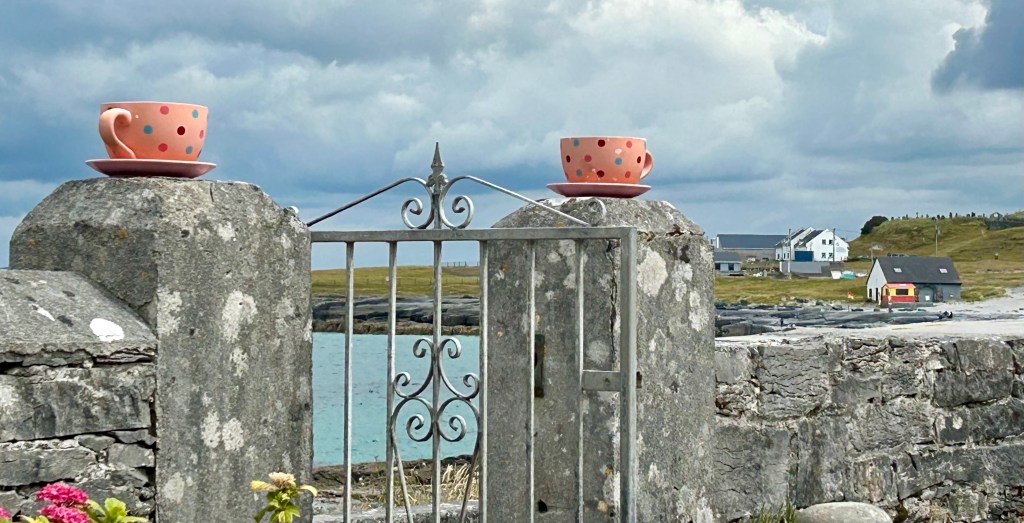
After an hour or so, I saw very dark clouds coming toward the island. I got up and walked down the road toward the ferry which was calmly waiting by the dock for us to board. Right before the long stretch of concrete walkway down to the boat, there was a sweet little tea shop. I decided to go in, get some tea, and sit in the outside seating area to write in this journal. On an island where people have lived since 1500 BC, life is very slow and that was alright by me.
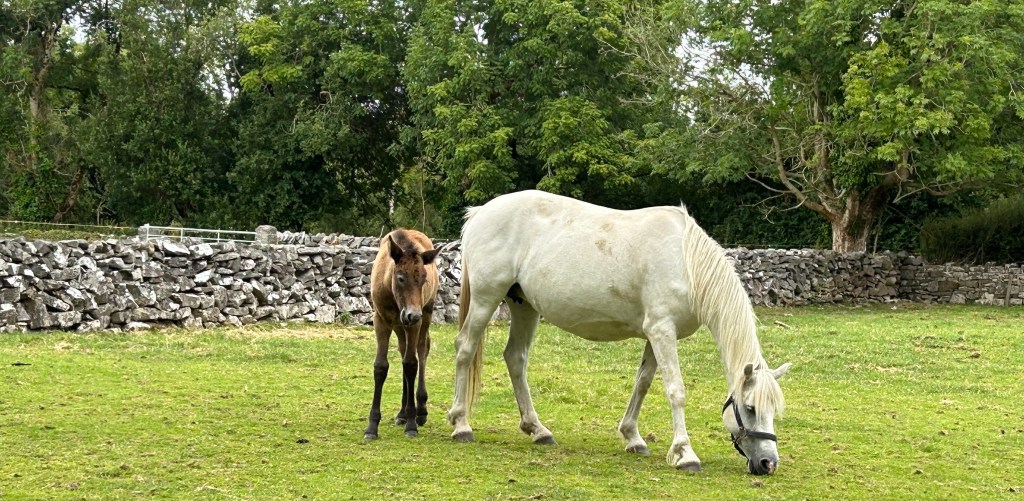
I spent most of the next day in the studio working on my third painting of Connemara. Will had been gone since the morning shooting photos at Lough Corrib. Geraldine had dropped him off there and was going to pick him up around three. I tagged along to pick up Will. She then drove us to see a castle. We rode with her down a wooded lane, and pulled into a small dirt parking lot. We started walking down a narrow path with a heavily wooded creek on one side, and someone’s series of small, rock-walled horse pastures on the other. The small yards were adjacent to their home. There were several young colts in the pastures with their moms.
We started to see the tall stone tower through the trees on the other side of the creek. It had been built on a large slab of karsified limestone. As we rounded the bend, there was so much more. Suddenly there was wide open space, walls, and structures within the walls, and wide areas of level ground and grass. This wasn’t an old ruin with a few tumbled structures. This castle was well-preserved and included a banquet hall and a watch tower. And even better, it was the castle of Grace O’Malley, the Pirate Queen, whose descendants are Padraig’s family. Aughnanure Castle was the fortress of Donal O’Flaherty who married Grace O’Malley.


Will and I returned home thankful for the tour and the insight into more local history. He was happy for a successful photo shoot, and I was enamored by yet another Connemara experience.
I spent the next two days working in the studio, finishing my third Connemara painting, and starting a small one from my visit to Inisheer. I went into Galway with Will, by taxi this time, to buy groceries and find a bookstore. I bought a book by Marion McGarry about Irish Cottages. (She’s probably another cousin.)
In the early evening, we had our artist Introduction meeting with Grace who had arrived from Dublin. We all shared our work and our processes, and how we developed as artists.
The next day, after finishing my painting around 4 p.m., I left the studio to go downtown to the Arts Festival. It started to rain gently, but by the time I got to the bus stop, it had stopped. I went to the Festival Garden on Eyre Square and ducked into a covered area with vendors as the rain began again. There I met a children’s book author from Galway, Martha Begley Schade, who writes stories for children about animals and fairies. They are called children’s well-being books. I had seen them in the bookstore the day before. We had a wonderful conversation. I bought her two books, and she signed them. I told her I would bring one of mine to her. I took the bus back to the edge of town, and walked the rest of the way home in the rain.
After spending most of the next day in the studio, Will and I walked into town to see the parade of Pegasus through the streets of Galway. We found a pub, and had dinner and a pint. Then we walked out to St. Brien’s bridge to watch the giant Pegasus sculpture pass by. It was a gorgeous evening, with blue sky and sunshine. I had decided that day that it was time for me to travel beyond Galway.

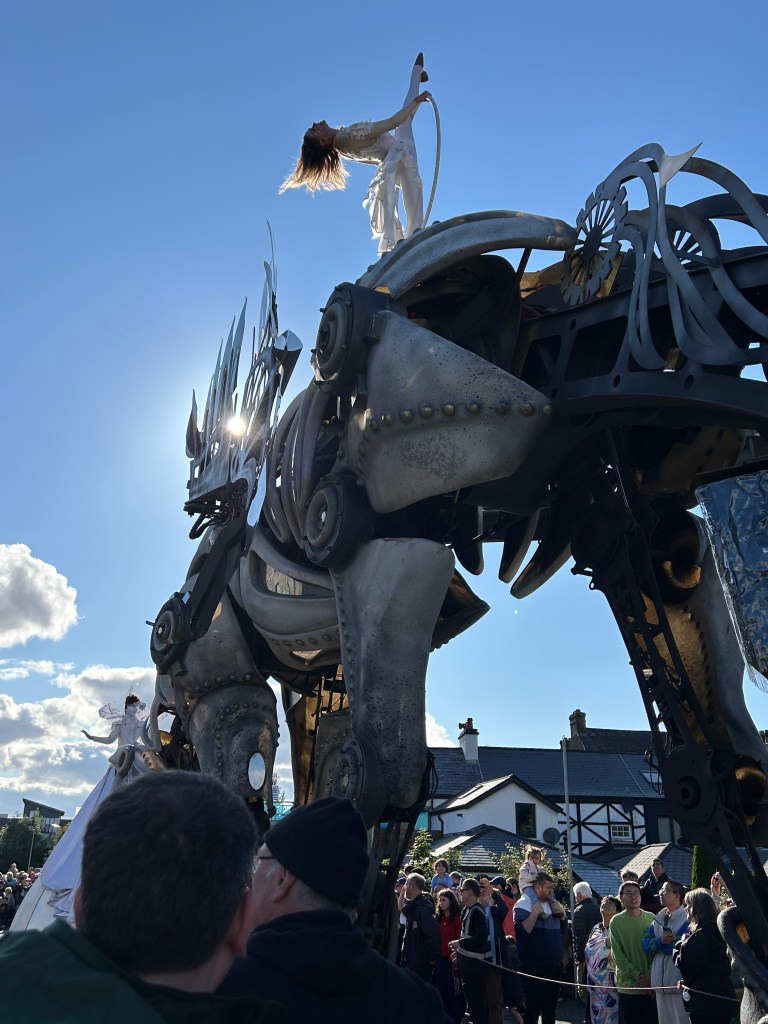
The next day in town, there was an aerial performance right on the square with a big crowd watching. I watched for a while, then bought some eggs to finish out the week before beginning my road trip. I went to Charlie Byrne’s bookstore and bought two children’s books about Grace O’Malley, the Pirate Queen. On my way back to catch the bus, I stood with a crowd at a major crossroad in the network of promenades in Galway and watched a magician from Southern California do his thing. Just as he finished, it began to rain.
That night while I was reading in my room, Will messaged me that Biden had finally announced he was stepping down from the presidential race. I was elated! Now I felt like I could return to the US with hope in my heart. What a relief! I ended up sleeping well that night.
Will and I were both working in our studio the next day when Geraldine came in, asking if we wanted to walk on a path she had told us about by the river which led all the way to town. She would drive us in the car until we reached the beginning of it, about a kilometer away. We both said yes and hopped in her car. She parked by the outermost edge of Galway University campus, and we began walking around a soccer field. When we reached the river side of the field, we walked on a trail through lush woods and views of the river beside us. Suddenly, like so many things in Ireland, we rounded a bend and had a sudden, clear view of Menlo Castle, a 16th century structure on the other side of the river. Another leap back in time! Then a short way up the path, we happened upon the ruins of “Martin’s Tea House Folly.” Built in the 19th century, it was meant for members of the Martin tribe to sit and drink tea while watching activities on the river. These things are all on a path that heads into the center of Galway.


After our walk, Geraldine dropped me off at the Spanish Arch in Galway so I could catch a bus. I wanted to travel to the end of the line from Galway to Carraroe, the last town before the southwestern tip of Connemara, where Galway Bay meets the Atlantic Ocean. The weather quickly became gray and rainy. But once I was on the bus, it was easy to enjoy the ride, and to be moving along a unique scenic highway. The bus drove by a busy promenade in Salthill just outside of Galway to the west, then by sandy beaches and tidepools. The land gently flows into the sea on this end of Connemara. We passed through Spiddal, a small village with a few pubs, shops, a craft village, and a church. The landscape became more rural, and the shoreline was lined with mudflats.
It was a rainy afternoon, and the scenery was drenched and a bit dreary. It made me think of what it must have been like when my ancestors lived there during the famine, in small stone houses with thatched roofs. Every once in a while, along the way, there was a thatched house which had been restored, and the cottage was occupied. But more frequently those stone houses stood in ruin with a newer house very near it on the same property. The further west the bus went, the more rock walls laced through green pastures.
When the bus reached Carraroe, the few of us who were left on the bus got off. The driver said the return bus would come in an hour. I went inside a supermarket and was greeted by various newspapers with headlines about Biden and Harris and the race for US president. I bought a paper and read the view of it all from Ireland .
There was little else to see in the town, so when the rain stopped, I went back to the bus stop and waited for the return bus. Just when I thought it was the sleepiest town ever, a large group of teenagers, with a young adult leading them, came walking around the bend all dressed for soccer. The line of kids kept coming. There were probably 70 kids all together. Many politely nodded to me as they passed. Soon a big charter bus pulled up, and they all got on to go back to wherever they all came from. Ireland is like that. Suddenly there is civilization just when you think you have found the most remote place.
The ride back on the bus was nice because it was a double-decker bus. I was the only person who got on, so I went up the stairs and sat in the very front seat. It was a great view. The rocking motion of the bus started putting me to sleep which had been something evading me the whole trip. I knew there was a good reason for me to take that bus ride.
That night, I began making travel plans for my last week in Ireland. In the morning, I finished up my sixth painting and knew it would be my last one. Will and I discussed how he would photograph my paintings the next morning. I ended up taking a nap, then went back to the studio for the evening to finish a small painting in my journal. It was time to move on.
The next day started with rain. Unfortunately, this was the day for our Open Studio. Friends of Geraldine and Grace were invited to come and meet the artists and view the art. I was working on a sketch in my watercolor journal. Will came into the studio, earlier than usual, and began photographing all my pieces. After he was done, I began packing up all my art supplies. I took one last excursion into Galway to get a couple of small frames for my two little paintings I was giving away. I walked to the bus stop in the rain, rode the bus in the rain, shopped in the rain, rode the bus back in the rain, and walked home in the rain.

I went into the kitchen, mixed together all the ingredients I had left in the fridge, and baked some tasty potato balls. At 4 p.m., we were ready to greet people with wine and snacks. A small number of people stopped by. We were done by 7. Will and I said our goodbyes to the O’Malleys since we would both be leaving in the morning. I spent some time fitting all my artwork, art supplies, clothes, and purchases into my suitcases. It was a squeeze. I was looking forward to some more travel adventures before flying home on August 1st.
Before Will and I got our taxi into Galway the next morning with all our luggage, I suggested we take one last walk down to the river. We had both walked through the pasture with horses and wildflowers, rock walls and fairy trees, several times during our stay, and frequently with Geraldine. We both agreed it had been a magical place to stay in so many ways.
Our taxi arrived at 8:05 a.m., and in no time at all we were at Eyre Square for the last time. Will boarded his bus at 9, and my train left at 9:30 from the same location. We said goodbye and went in our different directions out of Galway. He was headed to Shannon Airport and flying home to Boston and a family wedding. I was headed to Dublin where I would spend the night, then pick up a rental car at the airport the next morning for my week on the road.
I dozed as the train sped past fields of sheep and cows and horses, stopping at little towns along the way. I reached Dublin at noon and hauled my two suitcases and a daypack out of Heuston Station and on to the street. It was very challenging maneuvering my four-wheeled luggage over the cobbled sidewalks. I figured I would walk the two kilometers, and stop somewhere along the way to use a bathroom and get something to eat. But an older man saw me struggling to move my luggage along, and offered to help. He asked where I was going. When I told him, he insisted I shouldn’t walk, but should take the Tram. We were just about at the stop for it, and when we reached it, he insisted he was paying for both of us with his pass. He immediately swiped his card twice.
Moments later, the Tram pulled up and we literally squeezed on to a very crowded car with my two bags, and my bulging daypack. He asked me, through the crowd, where I was from and where I was going. When my stop was near, he and another couple of men gave me directions where to walk when I got off. They all insisted it was very close. The doors opened, and I dragged my luggage off of the Tram and thanked them all for their help. I was amazed and overwhelmed by how helpful they all were, but I was also a bit confused with all the various advice. Going on the directions of others makes me feel out of control of my own instincts, which are usually pretty good when it comes to finding my way. I started up a street, but missed the turn at the first corner and ended up several blocks away before I could see on my phone that I had gone too far. I was getting very tired and could tell I had better get some food in me. I stopped at a small coffee and burger hut right next to a large church and ordered some chips. This was a neighborhood of low-income housing. The church and adjacent hut seem to exist mostly as a service to the people of the neighborhood. I also think I looked very pathetic. They didn’t charge me for the chips, and gave me directions on how to get to my destination. Once again, I was amazed at how helpful and kind everyone was.
I finally found Molloy’s Pub and Apartments on a corner right under a bridge for the Tram. I was a block from City Centre in Dublin. This was a far cry from where I had just come. I dragged my luggage through the door into a bar where several men sat on a Thursday afternoon at about 1:15. I ordered a tall glass of water and a short glass of Guinness, and sat down to eat my chips. Immediately, one of the men at the bar asked if I was staying there. When I replied yes, he immediately asked the bartender if he would store my luggage in the back until my room was ready, which wasn’t until 3 p.m. Then he started talking up a storm and asking where I was from, but not in a creepy way. He was clearly being a kind and curious, helpful person even if he was somewhat inebriated.
Around 2:30, I wandered a couple of blocks away and bought a few food items at a deli on the corner, then returned to Molloy’s. My room was ready and, thankfully, the bartender who checked me in carried my giant suitcase up the three flights of stairs while I tried to follow with my carry-on and backpack. The steps were unusually steep. The room was extremely small, but very clean. There was a single bed, a tiny desk, and one of the smallest bathrooms I have ever seen. But there were clean towels and sheets, and all the basic amenities one would find in any motel room. I made myself at home, thankful to be able to lie down for a while. I watched some American news, including Kamala Harris’ speech in Houston. It was warm on the 3rd floor, and very noisy outside my window. I doubted I would get any sleep. I watched a couple of things on TV, wrote in my journal, ate my snacks, and slept from about 10 until midnight.
I was awakened by fiddle music and a strong female singer echoing off buildings from the bar two stories down, but was happy to be hearing it from my room instead of inside a crowded pub. The music stopped just after midnight. However, noise from sidewalk construction continued until almost 4 a.m. Loud banging and revving engine sounds kept me up all night. Traffic noise began around 6 a. m. along with seagulls as loud as barking dogs. But then, I chose to stay in the middle of the largest city in Ireland above a pub.
I booked a bus to the airport and found my way with all my luggage down three flights of narrow stairs, onto the streets of Dublin, and somehow landed in the right place about six blocks away to catch the bus. After a 20-minute ride to the airport, I found the car rental place, and by 10:20, I was on the road to Cork County. About an hour out of Dublin, the lack of sleep caught up with me, and I pulled off the highway at an area near Heath, and found a spot to park on a country road. I crawled into the backseat and slept for about an hour.
I woke up refreshed and was able to get back on the road. I decided I wanted to check out Limerick on the way, and stopped there around 2 to have lunch. I was surprised to see how big it was, and noticed the town had several universities. But it is a city, not a town. The buildings in the downtown area are all taller than any I saw in Galway, and younger. It seemed more like San Francisco than Europe. There are centuries old churches, and a castle named after a ruthless English King, John the 1st. Castles are fascinating since we don’t have them in the US. But, after all, they are fortresses and built for defending against and perpetuating violence. I ate lunch in Limerick, but didn’t explore further. I got back on the road and headed for Blarney.
I arrived at the Muskerry Arms Bar and B&B in Blarney just outside of Cork. Blarney is a lovely little town, not a city, and the place I was staying had a nice pub with an eating area for the restaurant, and very comfortable rooms, much like motels in the US. As always in Ireland, the room was very clean. It was a relief to have a room with more space. I was once again on the third floor above the bar, but down a hall a bit away from the pub.
After resting some, I went downstairs and had a salad and a glass of Guinness for dinner. Then I went upstairs and watched the opening ceremonies of the Paris Olympics. I went to bed early and slept through the night without waking to any noise. It was a gift!
Even though I generally wake up too early to get up, it was nice to just relax and have a slow morning. It felt great to be free, independent, and mobile with my rental car. Now I was in traveler mode which I know pretty well. I packed up my things and checked out by 9 a.m. Fortunately, there was a small grocery store next door. I bought brown bread, cheese, raspberries, and cranberry juice for the car. That way, I only had to eat out once a day, and hopefully the meal would involve vegetables.
I put everything in the car and almost drove away into Cork City. But I knew just across the park next to me was Blarney Castle. I had no interest in kissing the Blarney Stone, but to be that close and not even see it would be a lost opportunity. I looked up the fee. It was 17 euros for seniors. I was on vacation, so I decided to check it out.
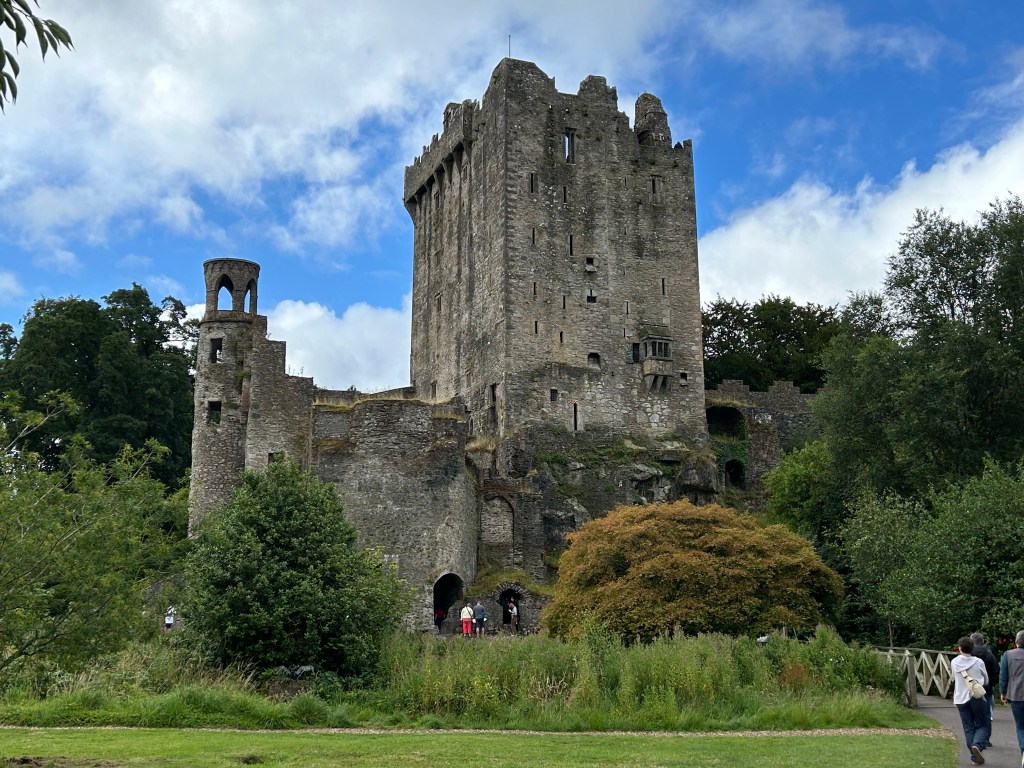
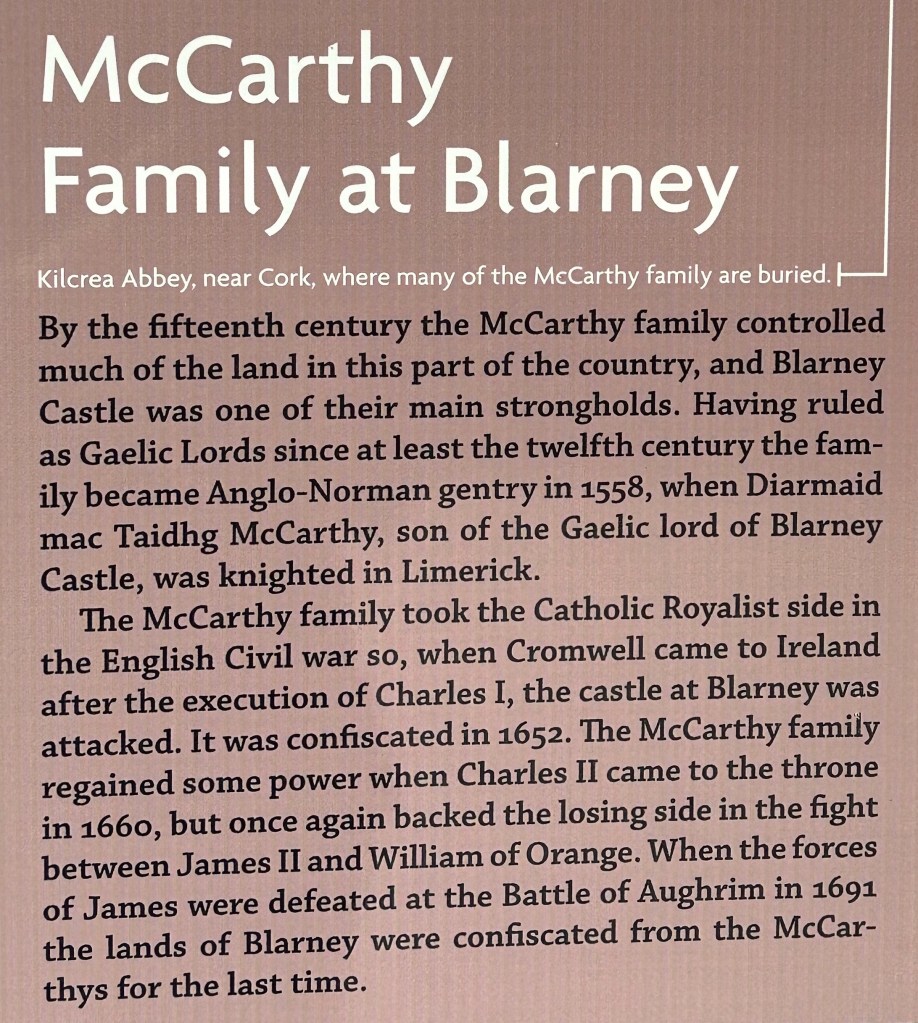
Something I didn’t know was that there is McCarthy family history there. I came to this part of Ireland to experience the surroundings of my ancestors. Whether it is certain or not, I am claiming to be part of the McCarthy clan connected to this castle!
By 10:30, I skipped driving into Cork City, and was on the road to Killarney to drive the Ring of Kerry. Google Maps took me through many backcountry roads. Finally, the journey graduated to one of the major highways. I was in Killarney in about an hour and a half. Following the signs to the Ring of Kerry, I passed through an area with dramatic mountains on my left. The Gap of Dunloe is in the middle of it. It was hard to get a good photo of it because there wasn’t a good place on the road to pull over. Geologically, the Gap of Dunloe is defined as a glacial breach which carved out a U-shaped valley.

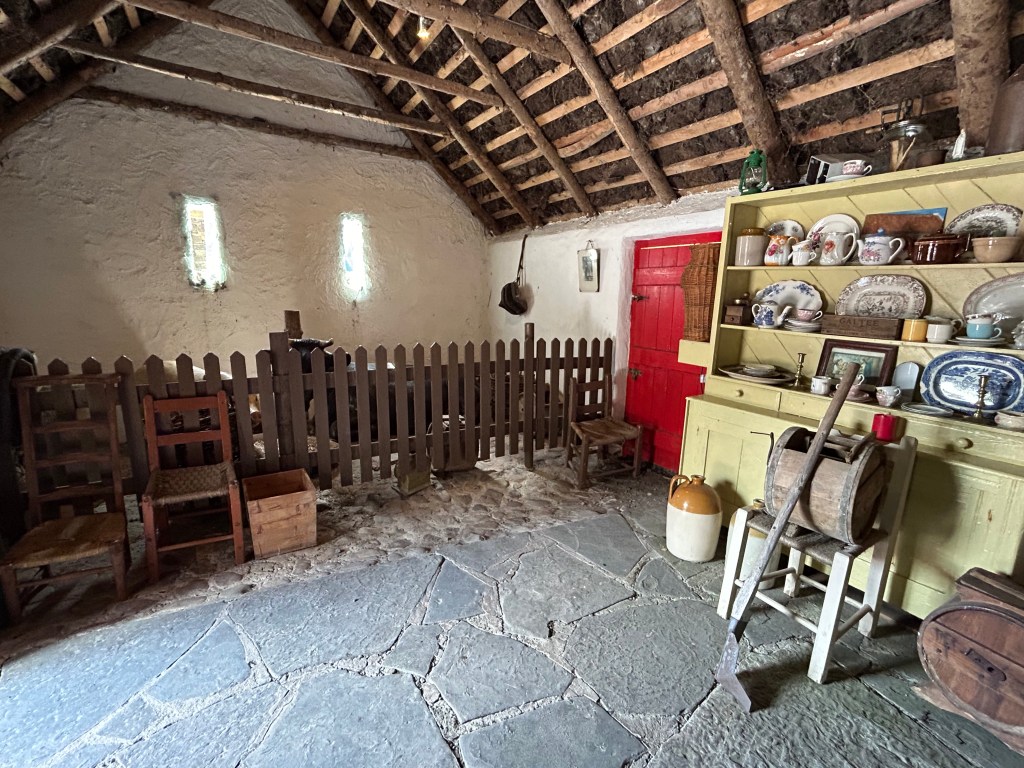
Over the years I have heard criticism of the famous Ring of Kerry. Some have said it is not worth seeing, or somehow didn’t meet their expectations. Well I say something must be wrong with those people. It was stunning! I arrived around noon. I stopped at the Kerry Bog Village, a place recommended by the man at the pub in Dublin. It is one of those places intended to share insight into how people lived in Ireland before and during the potato famine. This was helpful for me to learn about my ancestors. There were several thatched houses which tourists could enter and experience.


Further down the road, just around the bend, the landscape began to rise and only got better from there. It was stunning all the way. There will be so many paintings to come out of a beautiful, mostly sunny, five-hour drive around this beautiful peninsula.


After much misdirection by Siri, I finally arrived at The Killarney Grand where I had a reservation. Unfortunately, I was warned by them that I wouldn’t get a good night’s sleep, but not until after I had paid the non-refundable 50% deposit. It turns out they have live music every night until three in the morning. At first, I was relieved to find that my room at the end of a long hall on the third floor. But as nighttime approached, and the music began, and the whole building vibrated from the bass and drums. The music was a combination of disco and rock. I could hear crowds of young people on the streets participating in wild and raucous behavior. Another sleepless night.
I left Killarney around 9 a.m. and got on the road back to Dublin. I decided I would stop on the way in Moneygall which is about halfway between Killarney and Dublin. I had seen a sign on the road when I had been driving the other direction mentioning Barack Obama. I remember the news story of him visiting his maternal ancestral homeland. I pulled off and parked in this small village on a quiet, sunny Sunday morning. There is a main street about three blocks long. The town, of course, has a pub, a church, and a small school, but not much more than that.

Obama famously visited this town while president in 2011. I realized that part of why I was stopping there was because I was on my way to do the same thing. There is something significant about discovering your roots. For me, it has mostly to do with a sense of place. It also is about imagining the circumstances and struggles of my ancestors, how their choices and decisions impacted our lives. And then there is just feeling a connection.

I made my way down the highway a bit, but was getting sleepy. I stopped at the next Plaza I saw a sign for, and realized I could take advantage of the rest stop. I took a short nap in the back seat of my rental car.
Finally arriving in Dublin, I relied on Google Maps to find my reserved spot for the night. Tucked in near Merrion Square, a small building which had probably been used for something else was converted into rooms. It all seemed a little sketchy until I was in my actual room. Like all places I have stayed, it was clean, had all the amenities, and was comfortable. But it felt somewhat cave-like on the first floor of a nondescript brick building. I was in the city again. I never feel comfortable in cities.
After resting a while, I wandered out and picked a pub close by to eat my vegetables for the day. There is much irony in that sentence since pub food hardly has anything vegetarian, or even vegetable. This would be my third “Caesar Salad” for the week (always holding the bacon.) Ireland’s definition of Caesar Salad is “have some lettuce with your mayonnaise.” I couldn’t finish this one. It was just too much mayonnaise. And Guinness in Ireland is great, but very filling. I needed to walk off the bloated feeling, so I wandered around a bit and took photos of images that struck me in Dublin.


The next morning, I woke up early and was out of my room before 7 a.m. My car was parked just outside, but would be towed away if I didn’t pay for an hourly permit starting at 7. I made my way out of the city and aimed for the town where my great grandfather was born. Daniel Michael McGarry was born in Loughgiel, County Antrim in 1842. Margarette McCaughan, my great grandmother, was born in Ballycastle approximately 10 miles north on the coast that same year. The McGarry’s moved to Ballycastle at some point. Daniel and Margarette married each other 1871, and immediately set sail for America.
After crossing into Northern Ireland, Siri was saying miles instead of kilometers. But they still sold gas by the liter when I stopped to fill up. (This makes no sense to me.) I got helpful instructions from a nice man at the gas station on where I could do my laundry. They have “Services” along the highway which are the same as “Plazas” in the Republic of Ireland. It took an hour to do it, but I parked at an outdoor set of washers and dryers, and ended up with clean clothes.

Back on the road, I decided to bypass Belfast on the way north to avoid traffic and the hassle of city driving. Wandering through beautiful countryside, I arrived at Loughgiel around noon. It is barely a town, but, yes, there is a church and a pub. I pulled up next to the graveyard surrounding the back of the church. I thought I might see if they were any grave markers with the McGarry name. I stepped through the gate and was shocked to see the third stone read “McGarry.” I had found it so quickly! Then there was another right next to it, and another behind it. As I walked through the graveyard, there were more McGarrys than any other name. I was perplexed since written family history says my great grandfather’s family had moved to Ballycastle sometime after he was born. I photographed every McGarry tombstone.
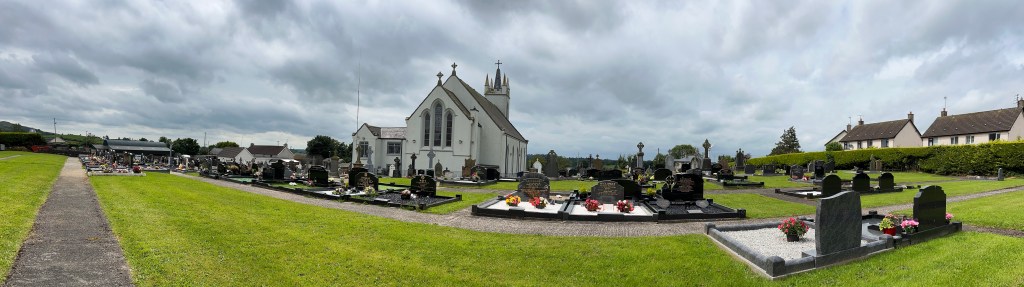
A woman arrived while I was looking around the graveyard. She comes there regularly to visit and “tidy” the site of her husband’s grave. We began talking, and a world of information came from Mary Mc-somebody, (I couldn’t see the full name on the gravestone because she had just put flowers in front of it.) She said the community was loaded with McGarrys, including Liam and Ita McGarry who live right across the road. They own the only pub in town, The Pound Bar. Mary encouraged me to go over and knock on the door to talk to Ita. “She should know all the McGarry family history,” said Mary.
Well, as much it is not like me to go knock on a stranger’s door unannounced, I knew many of my family members would have thought I should have, being there at that moment. So, knock I did. A man who must have been Liam, opened and asked, “Yes?” I quickly told him that Mary from the graveyard told me to talk to Ita about knowing anything about my family ancestry. He didn’t smile, but did invite me in. As I stepped into their living room, Ita, came in from the kitchen as Liam walked out of the room. She wasn’t smiling either, but invited me to sit down. I asked about Daniel McGarry and read from the papers my brother had sent me about him. Ita said she didn’t know of any Daniel McGarry. According to the genealogy written by my grand aunt, his father was also Daniel, but was from a town called Tober. Ita told me Tober was two miles down the road. “He must be from the McGarrys of Tober.” It seemed odd to me that she didn’t think there was any connection between her family and mine since they all lived in such close proximity in the past. Then she said she thought the McGarrys of Tober originally came from the west of Ireland. She suggested I go talk to James McGarry of Tober. She took me outside and pointed down the road, giving me very specific directions about how to get to his house. I thanked her and said goodbye, but I wasn’t taking this investigation any further. As fascinating as it was to imagine my ancestors coming from the west, where I had just spent three and a half weeks, I also had my own plans.
I continued my drive a few miles north to Ballycastle where my great grandparents grew up, met, and married. I had been there on my last trip, and even found the co-op where I had shopped before. I bought a few items, and got back on the main road of Giants Causeway. For this visit, I headed east instead of west out of town, and began my journey down the northeastern coast and the Glens of Antrim.
The views were stunning right away. Rounding the northeastern corner of Ireland, the road takes you past high, smooth, green hills and valleys, then drops down to Cushendun, a small resort village with a nice stretch of beach. I pulled over to take in the view and saw a distant stretch of land on the horizon across the water. I asked a man, and he confirmed we were looking at Scotland! Now I can say I’ve seen Scotland! He told me it was only 16 miles from that point across the water. Scotland stayed in view all the way down the coast.

I did take one of my sudden side trips when, as I was heading out of Cushendun, I saw a sign for a scenic route heading into the surrounding mountains. I turned onto an extremely narrow road which took me high above the canyon. (Glens in Ireland are hills and valleys.) I was driving along the ridges of one of the glens. Just when I thought I was finally far away from civilization, I reached a fork in the road, and for a second, didn’t know which way to go. But in that same second, I saw two men on bicycles who looked like they had just ridden up the hill. I rolled down my window and called to them to point the way back down to the coast. I could see they wanted to tell me more, so I stopped closer to them. These two men were at least my age or older. I was in awe of them! They gave me more detailed directions, which I didn’t really need. But that is the way in Ireland. If you ask for directions, they are usually very thorough. I politely listened to the whole story.

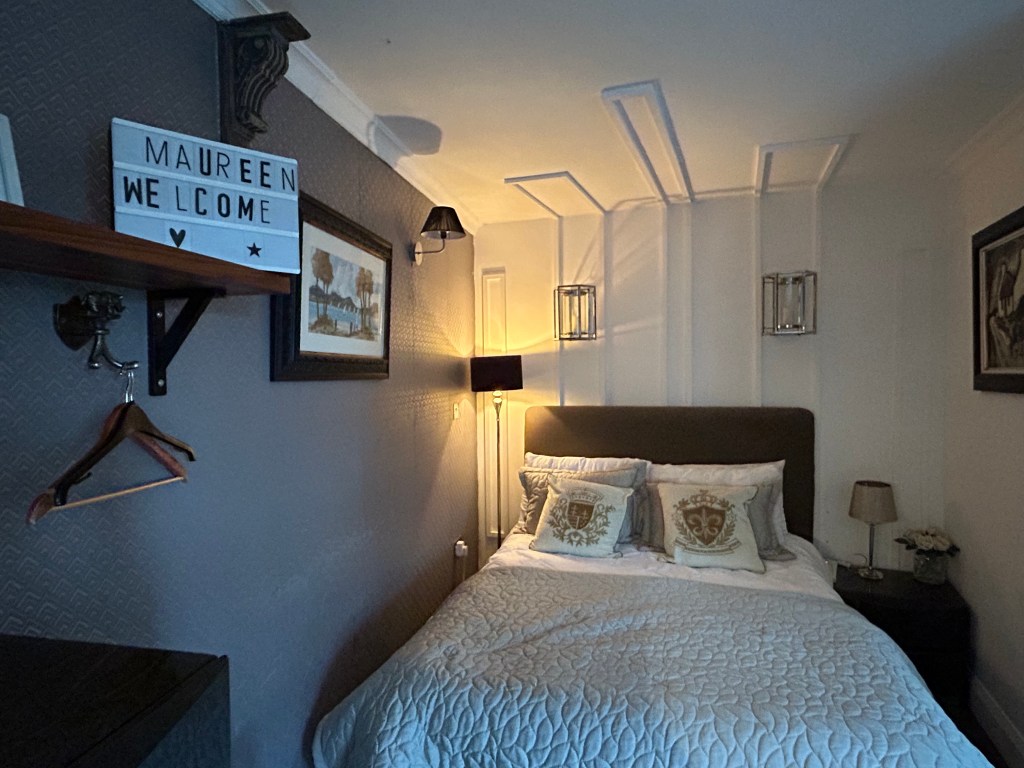
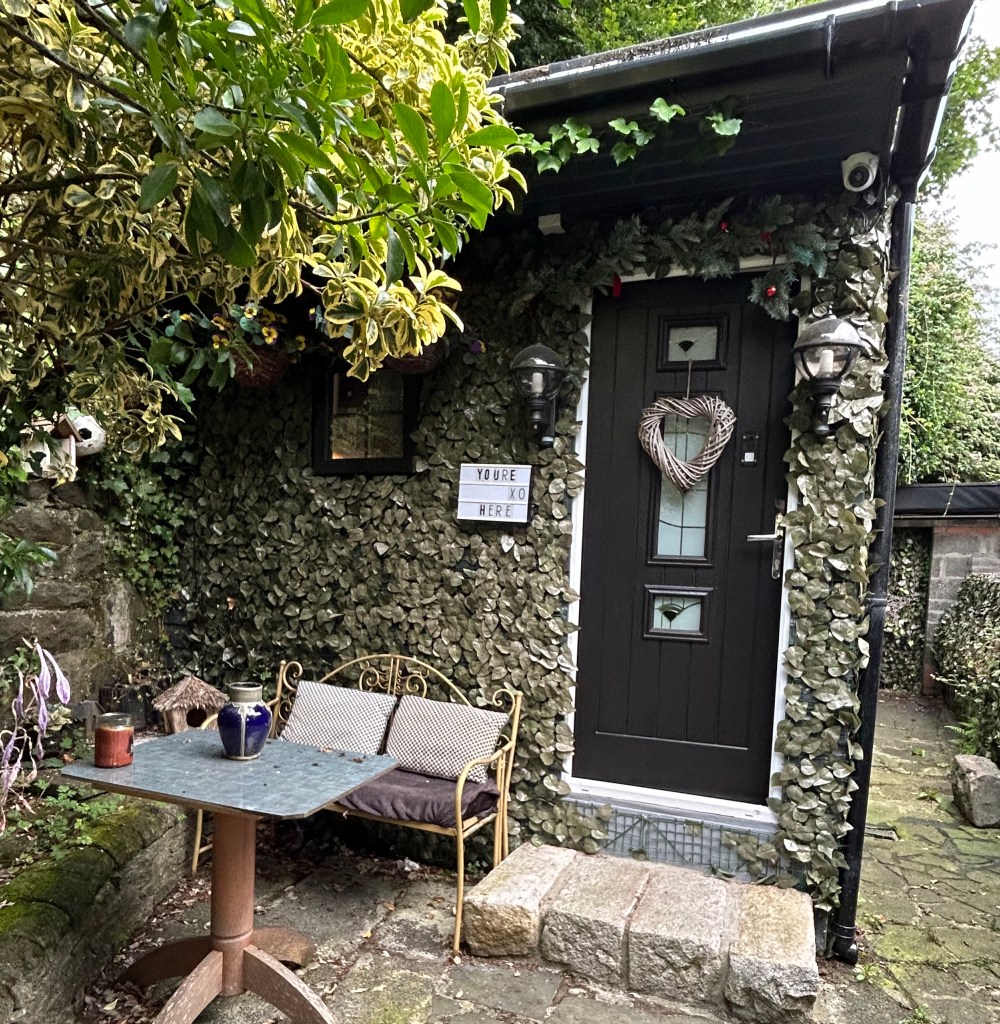
I finally rolled into Belfast around 6 p.m. It took me an hour to get through the city, and to find the place I had reserved. Siri mistakenly landed me in the middle of low-income housing. I felt like I was right in the middle of scenes from news stories and movies I have watched about the “troubles” in Belfast. I finally found my place for the night. And it was probably the cutest of all the places I had stayed. It was called “The Cosy Cabin,” and was tucked into an alley in a neighborhood of nice homes. It had been a former horse stable, but was completely converted into a really nice guest house. Once again, I did not meet the proprietor, but was able to get in and be safe inside this little gem. I slept well that night.
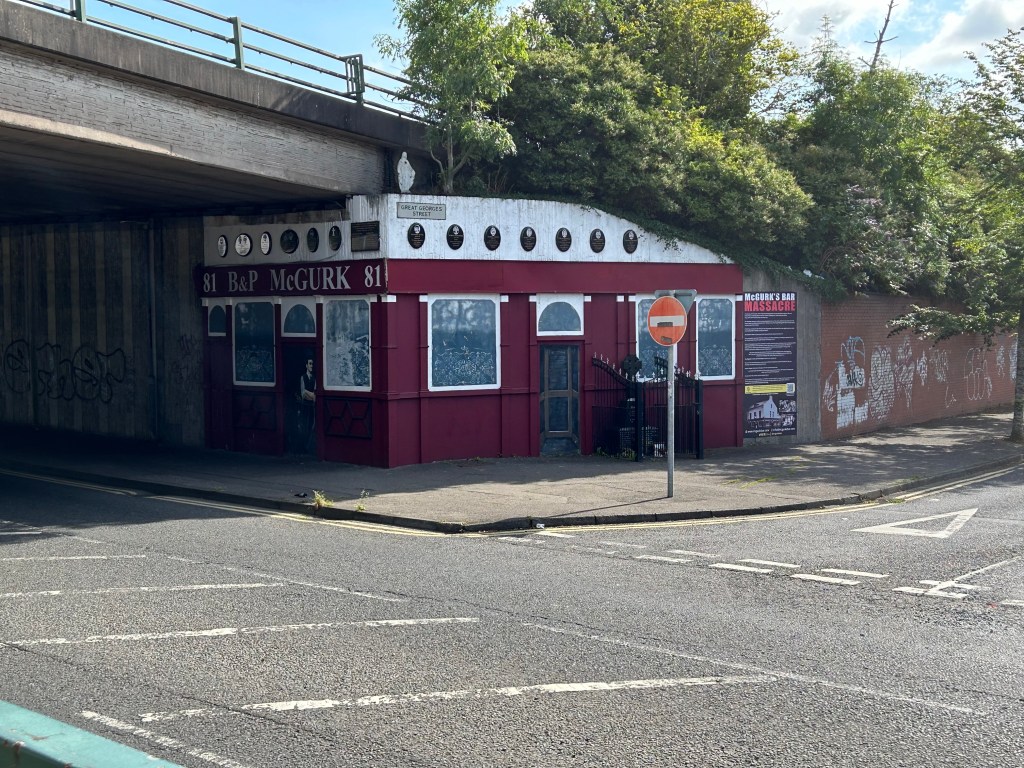
I was ready to go by 9 a.m. the next morning, but wanted to take a few photos of Belfast before heading back to Dublin. I saw row houses with graffiti. I found a large sign hanging on a fence calling for Irish Unity. There was a mural of a bombed-out pub called McGurk’s. And there was a scary-looking Anglican church next to Orange Hall on the main street through Belfast.


I left Belfast and drove back to Dublin. My sister Mary Pat and her husband Matt had landed in Dublin the night before. We wanted to meet up once they caught up from their jetlag. I found my next place to stay only two blocks from their hotel. After a short rest, I went to check out Trinity College. I caught the bus, and when I got off, I was on a bustling sidewalk on a sunny day in Dublin with people and pubs and sidewalk cafes. I walked toward campus and through a dark hallway into an impressive courtyard. It was nice to finally see Trinity’s campus.
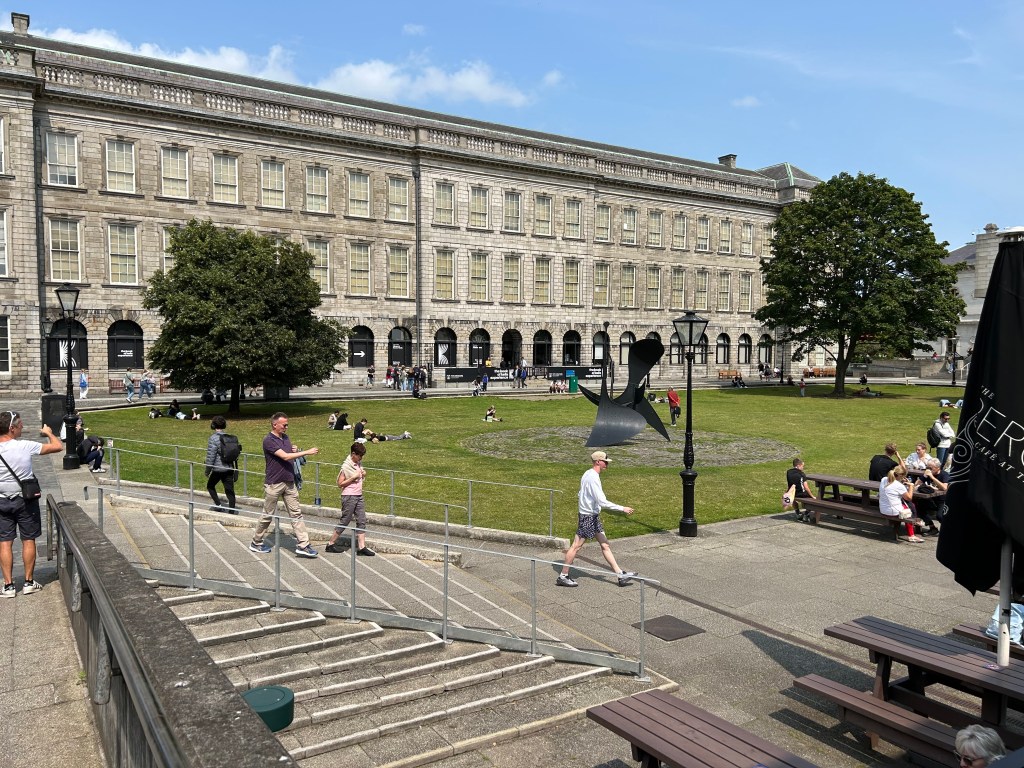

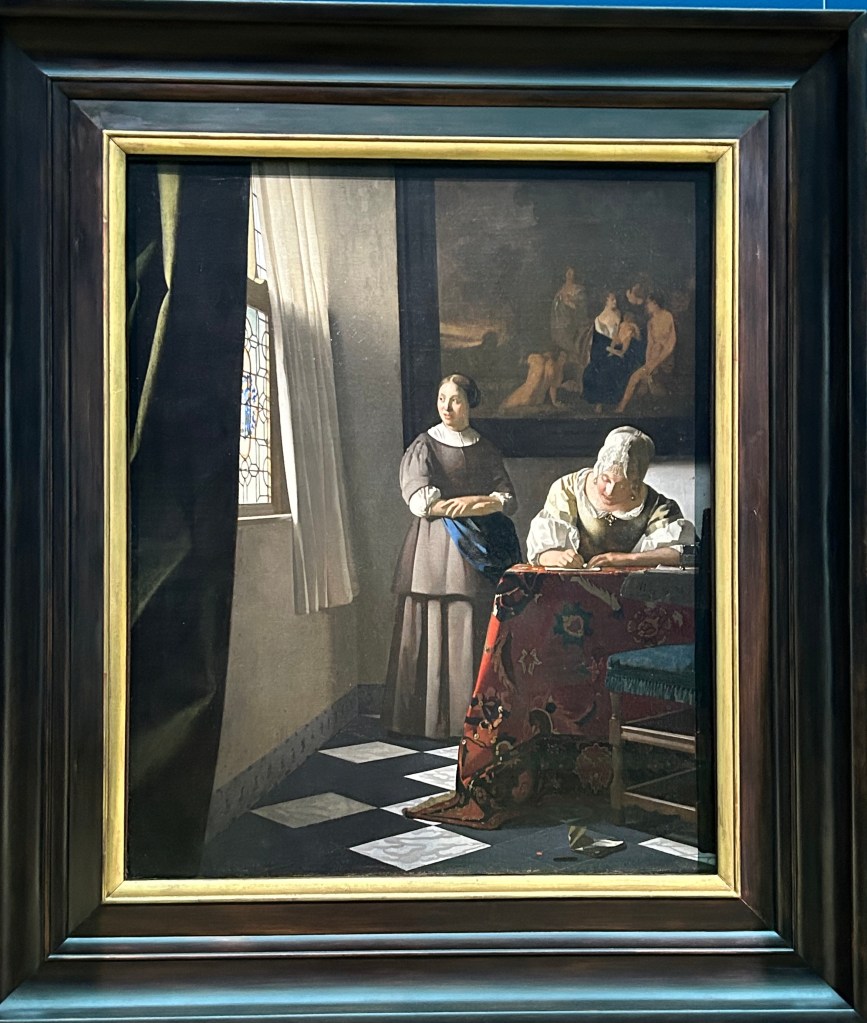
I walked across from the campus to the National Gallery of Ireland and looked at many oil paintings of Italian Art. They also had a special display of two Vermeer paintings on loan. One of the rooms felt like I was in a royal palace. It was huge! The museum was free.


I took the bus back to my hotel room and contacted Mary Pat and Matt, then walked over to their hotel. After a visit, we went around the corner to a nice pub and had really fresh and delicious salads for dinner. We walked over to St. Stephen’s Green, a lovely city park near the campus. Many people were out and about on a warm evening, enjoying the pleasant weather. We walked back to my hotel room, and visited some more until fatigue set in for all of us.
My final day in Ireland was spent at EPIC, the Irish Emigration Museum. It was a fascinating and thorough explanation of the reasons for and the journey of Irish people to other parts of the world. Visitors wander through a network of displays full of information and presented with creativity and immersion. I was totally taken in. It was the perfect ending to my month in Ireland. It helped me realize what having an Irish identity means to me, and why I feel a connection to my ancestors. Anyone who has a drop of Irish blood in them needs to experience this place. I left feeling a sense of completion, and wandered my way back through the streets of Dublin with a love for the country I had the opportunity to live in for one month. I will miss Ireland. There is no doubt in my mind that Ireland is in my blood, and is where I come from.
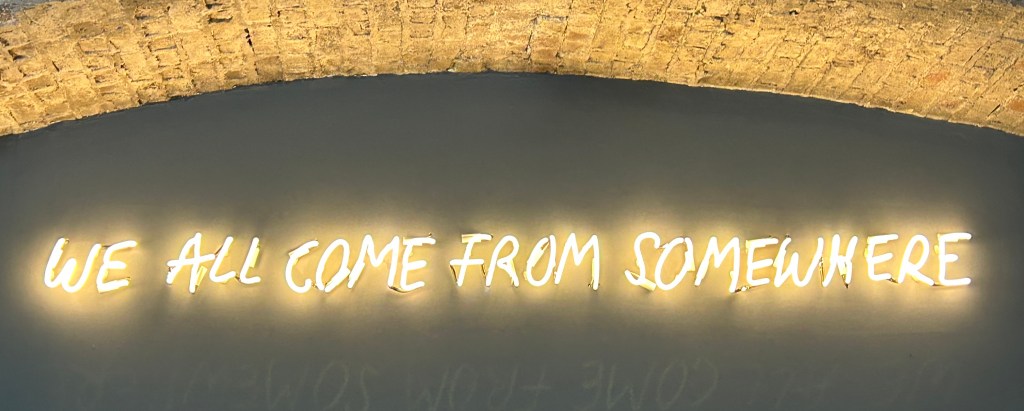
From the EPIC Museum in Dublin
 Maureen McGarry